Description
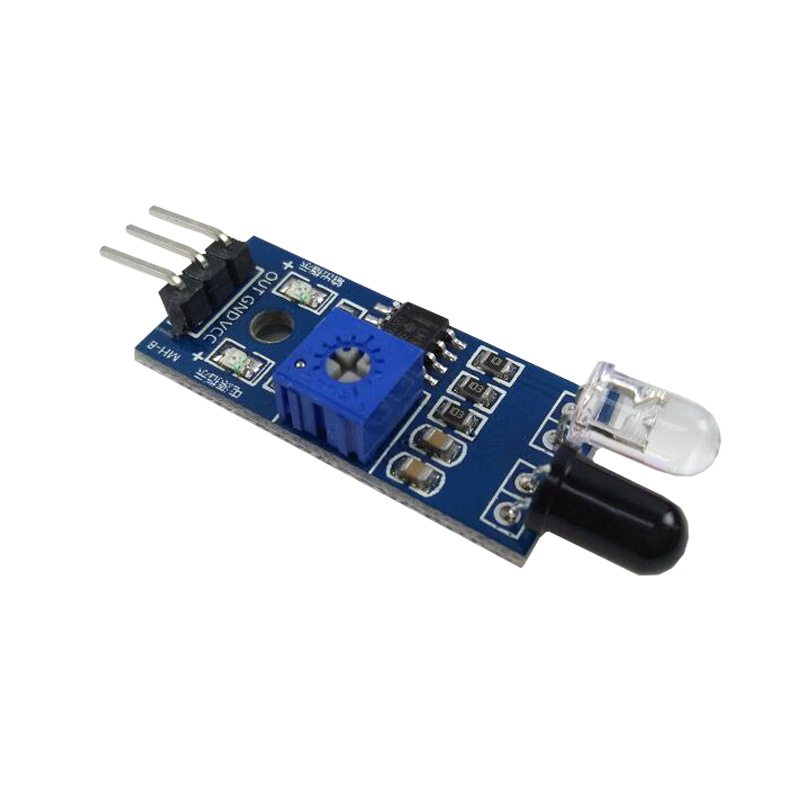
The IR Sensor Module (Infrared Obstacle Avoidance Sensor) is a widely used sensor in electronics, robotics, and automation projects. It works by emitting infrared (IR) light from an IR LED and detecting the reflected light using a photodiode receiver. When an object comes within the detection range, the reflected infrared signal is processed by the onboard LM393 comparator, generating a digital output signal for microcontrollers like Arduino or Raspberry Pi.
This sensor module operates at 3.3V–5V, making it compatible with popular development boards such as Arduino, ESP32, Raspberry Pi, and other microcontrollers. It also features an adjustable potentiometer that allows users to set the detection distance depending on their application.
The typical detection range of the module is 2cm to 30cm with a detection angle of about 35°, making it suitable for short-range obstacle detection.
Because of its low cost, small size, and easy interface, this IR sensor module is commonly used in robot obstacle avoidance systems, line-following robots, smart security systems, and automated devices.
Key Features
Infrared obstacle detection sensor
LM393 comparator chip for stable output
Adjustable detection range using onboard potentiometer
Digital output signal for microcontrollers
Compatible with Arduino, ESP32, Raspberry Pi
Onboard power and detection indicator LEDs
Compact and lightweight design
Specifications
Sensor Type: Infrared Obstacle Sensor
Operating Voltage: 3.3V – 5V DC
Detection Distance: 2cm – 30cm (adjustable)
Detection Angle: 35°
Comparator Chip: LM393
Output Type: Digital (High / Low)
Current Consumption: ~20mA
Interface Pins: VCC, GND, OUT
Board Size: approx. 31mm × 14mm
Pin Configuration
VCC – Connect to 3.3V or 5V power supply
GND – Ground connection
OUT – Digital output signal to microcontroller
Applications
Robot obstacle avoidance
Line-following robot car
Smart automation systems
Object detection systems
DIY electronics projects
IoT development projects


Reviews
There are no reviews yet.